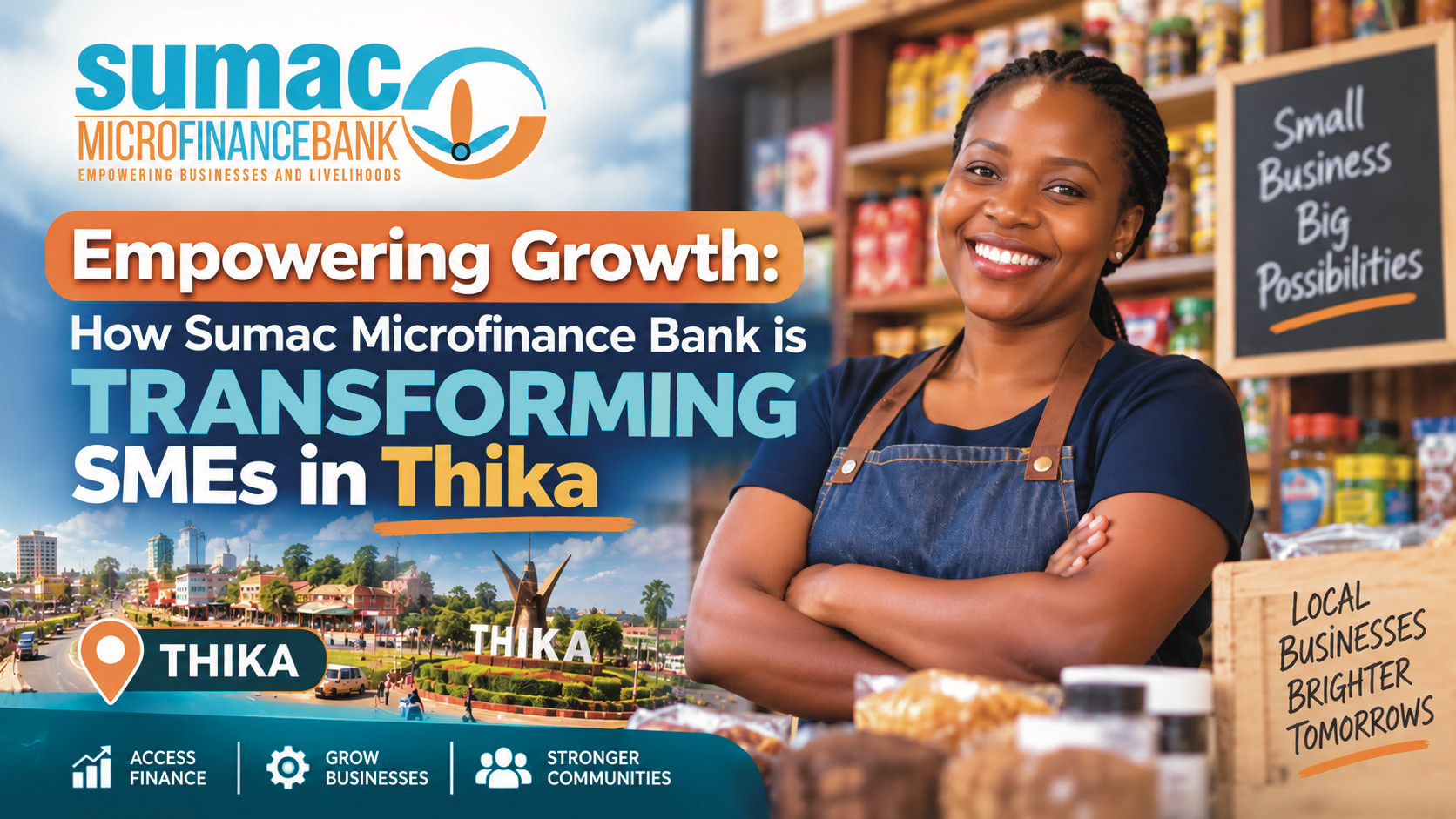
In the bustling industrial and commercial hub of Thika, where manufacturing workshops, retail outlets, agribusiness ventures, and service enterprises form the backbone of the local economy, access to timely and appropriate financing has long determined whether small and medium enterprises (SMEs) merely survive or truly scale. Sumac Microfinance Bank has emerged as a pivotal partner in this transformation. Through its dedicated Thika Branch—opened in 2019 at Nafelin Plaza along Mama Ngina Drive—and a suite of business-focused products, the institution has systematically addressed the financing barriers that have historically constrained SME growth in the region and across Kenya.
Thika’s SMEs operate in a dynamic yet challenging environment. The town hosts a mix of formal and informal businesses, including hardware traders, Jua Kali artisans, transporters, dairy and horticultural producers, retailers, and light manufacturers. These enterprises contribute significantly to employment and local economic activity, yet many have struggled to secure the capital needed for inventory expansion, equipment upgrades, working capital, or market diversification. Sumac’s model—rooted in relationship banking, flexible collateral requirements, rapid processing, and products tailored to real business cycles—has provided a practical pathway for these entrepreneurs to upscale and expand.
Kenyan SMEs, including those in Thika, face well-documented structural barriers when approaching traditional financial institutions. High collateral requirements frequently exclude owners who lack title deeds, formal property, or substantial fixed assets. Many operate with limited formal financial records or bank statements, making conventional credit assessment difficult. Interest rates and processing timelines from commercial banks have often proven prohibitive, while rigid documentation demands and lengthy approval processes fail to match the fast-moving cash-flow realities of small businesses.
Studies focused on Thika and similar localities highlight additional constraints: inadequate loan amounts relative to actual needs, limited awareness of available products, information asymmetry between lenders and borrowers, and a preference among some entrepreneurs for informal sources such as personal savings, family, or chamas due to perceived inaccessibility of formal credit. High perceived risk by banks, coupled with elevated non-performing loan rates in the MSME segment, has further tightened lending appetite. The result is a financing gap that forces many viable businesses to forgo expansion opportunities, remain undercapitalized, or rely on costly short-term informal credit that erodes margins.
Sumac was founded precisely to serve this underserved segment. Established in 2002 by a group of investors and licensed as a deposit-taking microfinance bank by the Central Bank of Kenya in 2012, the institution prioritizes business-oriented lending. Its philosophy centers on understanding the distinctive needs of entrepreneurs rather than applying one-size-fits-all commercial banking criteria. The opening of the Thika Branch in 2019 was a direct response to demand from Central Kenya businesses seeking a closer, more responsive partner.
Sumac’s product suite is designed around the practical realities of SME operations. Flagship offerings include the Business Loan, which provides working capital ranging from KSh 50,000 to KSh 10 million for established entrepreneurs. Security can include title deeds, logbooks, shares, fixed deposits, or third-party arrangements, with a one-month grace period and processing typically completed within 48 hours once documentation is in order. This speed and flexibility allow businesses to respond quickly to market opportunities such as seasonal stock-ups or supplier discounts.
For micro and small enterprises—general shops, hardware stores, Jua Kali artisans, and agribusiness traders—the Inua Biashara Loan offers amounts from KSh 5,000 to KSh 300,000. Collateral is more accessible, encompassing guarantors, business stock and assets, household chattels, or livestock. Requirements focus on an existing business of at least one year, account maintenance with Sumac, identification documents, and evidence of need such as LPOs or invoices. Approval within 48 hours makes it particularly valuable for cash-flow management and modest expansion.
Asset finance enables the acquisition of productive assets—vehicles, machinery, equipment—with the financed item often serving as primary security, reducing the need for extensive additional collateral. Trade finance solutions and related facilities, support supply-chain and project-based needs. Agribusiness products such as Kilimo Biashara further assist farmers and related enterprises with livestock, inputs, and equipment financing, aligning with Thika’s peri-urban agricultural activity.
Complementary services—savings and current accounts, fixed deposits, forex, bancassurance (including SME insurance covering fire, burglary, business interruption, and related risks), and mobile banking—create an integrated ecosystem. This holistic approach allows clients to manage both financing and risk protection under one relationship.
Sumac systematically mitigates the challenges that deter SMEs from formal funding. Flexible and alternative collateral options lower the entry barrier for businesses without conventional title deeds. Character, purpose, and repayment capacity assessments, supported by chattels or stock where appropriate, replace rigid asset-based models. Rapid 48-hour processing contrasts sharply with longer commercial bank timelines, matching the urgency of business opportunities. Relationship-focused engagement—staff who understand local markets and maintain ongoing contact—builds trust and enables tailored structuring rather than standardized rejection.
By accepting evidence of business activity (receipts, contracts, utility bills) alongside basic formal documents, Sumac accommodates semi-formal operators common in Thika. Grace periods and flexible repayment aligned with cash-flow cycles reduce default risk and support sustainable growth. The institution’s track record of awards, including recognition for agriculture and livestock financing and overall microfinance performance, reflects consistent delivery on these principles.
In practice, these features translate into measurable business growth. Working-capital facilities enable larger inventory purchases, better supplier terms, and the ability to fulfill bigger orders. Asset finance turns equipment or vehicle dreams into immediate productive capacity, increasing output and efficiency. For transporters, distributors, and service providers in and around Thika, such financing supports fleet expansion or modernization. Retailers and artisans can move from survival-mode stock levels to competitive assortment and volume, while agribusiness clients improve yields and market access.
The Thika Branch positions Sumac to serve the greater Central Kenya region effectively, reducing travel and accessibility hurdles that previously limited engagement with Nairobi-based institutions. Local presence fosters deeper understanding of sector-specific risks and opportunities—whether in manufacturing, trade, or agriculture—allowing more accurate credit decisions and advisory support. Over time, successful clients often progress from smaller Inua Biashara facilities to larger Business Loans or asset finance, creating a clear growth trajectory.
Beyond individual enterprises, the cumulative effect supports broader economic multipliers: additional employment, stronger local supply chains, increased formal economic activity, and greater resilience against external shocks. MSMEs remain central to Kenya’s employment and GDP contribution; institutions that reliably channel capital to them strengthen the foundation of inclusive growth.
The recent majority acquisition of Sumac by Moniepoint Inc. introduces additional capital, digital capabilities, and scale while preserving local expertise and customer relationships. This development is expected to enhance product innovation, lending capacity, and technological delivery for Kenyan SMEs, including those in Thika.
Sumac’s approach demonstrates that effective SME financing rests on proximity, product design that respects operational realities, speed, and a genuine partnership orientation. For entrepreneurs in Thika seeking to move from constrained operations to deliberate expansion—whether through larger working capital, productive assets, or market reach—the institution has established itself as a practical and reliable ally. By removing the traditional barriers of collateral rigidity, slow processing, and mismatched products, Sumac continues to turn ambition into tangible business growth across the region.