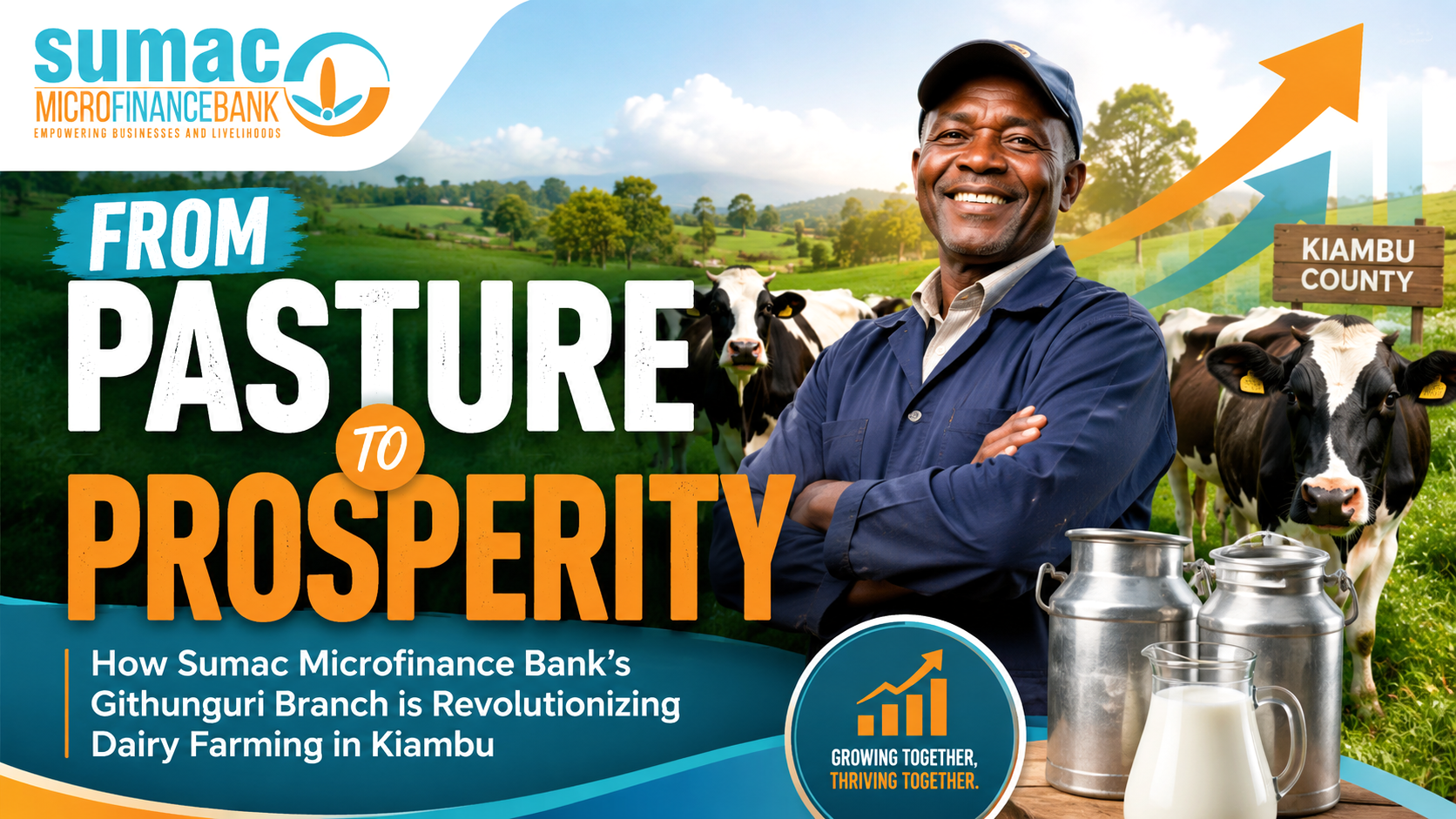
In the lush, green hills of Githunguri, Kiambu County – Kenya’s dairy heartland – the rhythmic lowing of cattle and the steady churn of milk processing define daily life. For generations, smallholder dairy farmers here have wrestled with the challenges of scaling their operations: high costs of quality breeds, feed, veterinary care, and equipment, all while navigating volatile milk prices and limited access to formal credit. Traditional banks often viewed these farmers as high-risk, demanding collateral that many lacked. But since its establishment, Sumac Microfinance Bank’s Githunguri Branch has emerged as a transformative force, empowering hundreds of dairy entrepreneurs to turn modest herds into thriving agribusinesses.
Located opposite the Githunguri Police Station, the branch serves as a vital financial lifeline for farmers across Githunguri and surrounding areas in Kiambu County. As one of Sumac’s key expansions beyond Nairobi, it has specialized in understanding the rhythms of rural agribusiness, particularly dairy farming – the lifeblood of the local economy. Through tailored products like the Kilimo Biashara Loan and asset financing, the branch has enabled farmers to acquire high-yield cows, modern equipment, and working capital, fostering remarkable growth stories that ripple through families, cooperatives, and the wider community.
This is more than banking; it is a partnership in prosperity, turning potential into plenty in one of Kenya’s most productive dairy regions.
Sumac Microfinance Bank began in 2004 with a group of 14 visionary investors, many retrenched professionals, pooling modest resources to support overlooked micro and small enterprises. Under the stewardship of Chairman John Kibatha Njoroge, the institution evolved from a credit-only entity to a fully licensed deposit-taking microfinance bank in 2012. Its mission has always centered on empowering the “common folk” – those driving Kenya’s real economy.
The Githunguri Branch, opened around 2015, marked a strategic push into Kiambu County’s agricultural powerhouse. The then Branch Manager Philip Kimani and his team faced initial hurdles – building trust in a community skeptical of formal finance – but quickly made inroads through aggressive, community-focused marketing and client-centric services. Today, under the leadership of Catherine Munene as the current Branch Manager, the branch stands as a cornerstone, with a significant portion of its portfolio dedicated to agribusiness, especially dairy.
Chairman Kibatha Njoroge speaks with deep satisfaction about this chapter: “Githunguri represents everything Sumac stands for – going where the people and the opportunities are. Dairy farming in this region isn’t just a business; it’s a way of life sustaining thousands of households. When we opened the branch, we committed to understanding the unique cycles of farming: the calving seasons, feed costs, milk flows. Our role is to de-risk that journey and amplify success. The results we’re seeing – farmers growing from a few cows to dozens – validate that vision.”
Under CEO John Njihia’s leadership, Sumac has refined its agribusiness offerings, leveraging partnerships with various funders to expand reach and impact. Njihia, with his finance expertise, has championed quick disbursements and flexible terms that align with farmers’ cash flows.
The Githunguri Branch’s success hinges on products designed for the realities of dairy farming. The Kilimo Biashara Loan stands out: ranging from Ksh5,000 to Ksh300,000 (with potential for larger facilities), it supports inputs, livestock purchase, and operations. Security often includes insured dairy cows, with Sumac as first claimant – a farmer-friendly approach that minimizes traditional collateral barriers.
Asset finance complements this, enabling the acquisition of milking machines, chaff cutters, biogas systems, and transport vehicles. Business loans provide working capital for feed, veterinary services, and expansion during lean periods. Processing times as short as 48 hours ensure farmers can seize opportunities, like buying quality breeds during market dips.
CEO John Njihia explains the strategy: “Dairy farmers in Githunguri are entrepreneurs at heart, but they need capital that respects agricultural cycles – not rigid urban banking schedules. Our products at the Githunguri Branch are built for that. We finance the purchase of high-grade cows, barn improvements, and value-addition equipment. More importantly, we follow up with advisory support. This isn’t transactional lending; it’s ecosystem building. The repayment rates and growth stories from clients like James Kinga and Henry Nene prove the model works powerfully.”
The branch’s team regularly visits farms, hosts client reconnection events (drawing over 60 farmers), and collaborates with cooperatives, fostering financial literacy and best practices in breeding, feeding, and record-keeping.
The human impact is profound. Take Henry Nene, a Githunguri dairy farmer whose journey exemplifies Sumac’s catalytic role. When he first walked into the branch, he secured a loan to kick start his dairy operation. Just three years later, he had built a herd of about 28 high-yielding cows. In video testimonials, Nene speaks passionately about consistent support enabling him to expand steadily, improve genetics, and generate stable income for his family. His success has inspired neighbors and strengthened his position in local cooperatives.
Similarly, James Kinga begun his journey as a Boda Boda rider. When he first visited Sumac Microfinance Bank, he didn’t know that a few years later, he would be the proud owner of an apartment block, two motor vehicles, a pork business, restaurant and a thriving pork butchery at the heart of Ndumberi town. James credits Sumac’s understanding partnership for making scaling feasible.
These stories are replicated across the branch’s clientele. Farmers use loans to upgrade from indigenous to high-grade Friesian or Ayrshire crosses, invest in zero-grazing units for higher productivity, and purchase vehicles to deliver milk efficiently to processors like Githunguri Dairy. The ripple effects are visible: increased milk production boosts cooperative societies, enhances food security, and injects money into local economies through feed suppliers, vets, and laborers.
In a region where dairy supports livelihoods for thousands, Sumac’s interventions have helped farmers weather challenges like rising feed costs and climate variability, turning potential setbacks into sustained growth.
The Githunguri Branch’s work extends far beyond individual farms. By empowering smallholders – who form the backbone of Kenya’s dairy sector contributing significantly to GDP and employment – Sumac fuels a virtuous cycle. Successful farmers educate their children, invest in community projects, and strengthen cooperatives, which in turn improve milk collection, quality control, and market access.
Chairman Njoroge reflects on the macroeconomic significance: “Kiambu’s dairy sector is a national asset. Our Githunguri Branch has shown that microfinance, when rooted in local knowledge and paired with responsible lending, can drive inclusive growth. We’ve seen women farmers rise as leaders, youth entering the sector with modern techniques, and entire value chains gaining resilience. This aligns perfectly with Kenya’s broader goals of agricultural transformation and financial inclusion.”
CEO Njihia looks ahead with ambition: “With the recent strategic developments, including enhanced capital and digital tools, we are poised to deepen our agribusiness focus. Imagine more farmers accessing solar-powered milking systems or climate-smart feeds. The Githunguri Branch will continue as a hub of innovation, partnering with cooperatives and funders to scale impact even further. Our clients aren’t just repaying loans – they’re building legacies.”
Success has not been without obstacles. Farmers face disease outbreaks, market fluctuations, and infrastructure gaps, while the bank manages credit risks in a sector prone to seasonality. Yet Sumac’s hands-on approach – insurance tie-ups for livestock, flexible repayments, and ongoing engagement – has yielded strong portfolio performance.
The branch’s community events, customer service excellence (highlighted during annual Customer Service Week), and recognition in industry awards underscore its credibility. As Sumac grows its footprint in Kiambu with additional marketing offices, Githunguri remains the pioneering anchor for agricultural finance.
In Githunguri, where white gold flows from healthy herds, Sumac Microfinance Bank’s branch has rewritten the narrative of possibility. From James Kinga’s story to Henry Nene’s remarkable succees, and countless others scaling quietly, the institution has proven that accessible, empathetic finance can transform subsistence into surplus, struggle into stability.
Chairman Kibatha Njoroge and CEO John Njihia share a unified message: this is sustainable empowerment. For dairy farmers in Githunguri and beyond, Sumac isn’t merely a lender – it is a committed ally in the quest for prosperity.
As Kenya’s dairy sector evolves amid modernization and market demands, the Githunguri Branch stands tall: a beacon of hope, a driver of change, and a powerful testament to what happens when finance meets the farm with understanding and unwavering support. The hills of Githunguri are greener, the buckets fuller, and the futures brighter – one empowered farmer at a time.